
A modified group self-assessment procedure
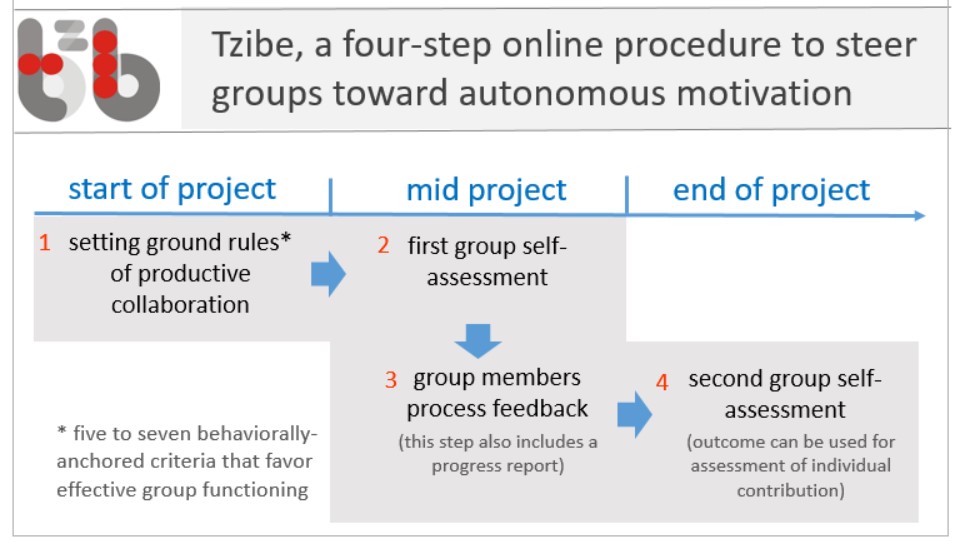
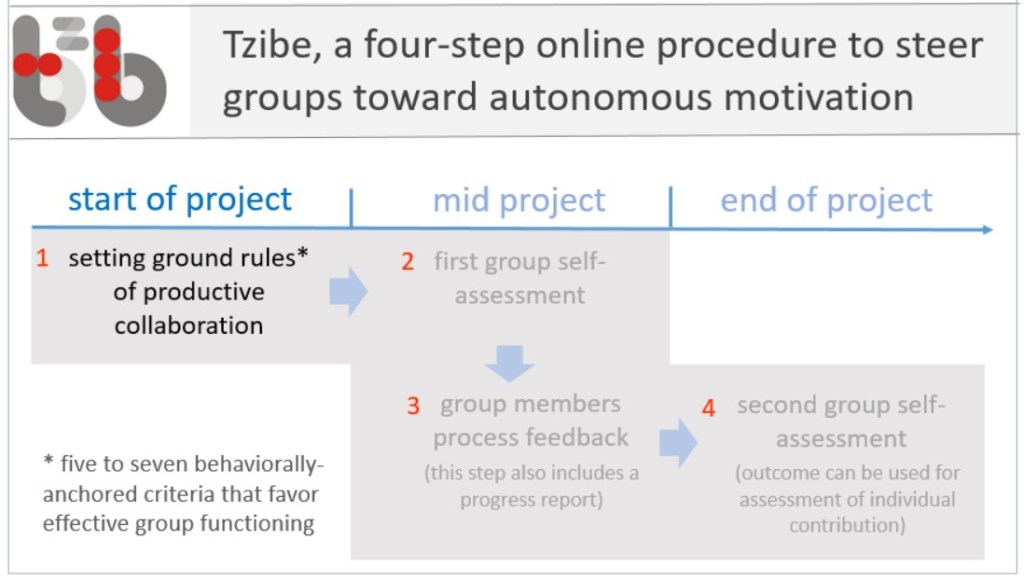
The self-assessment procedure we have developed is based on a “category approach”. It differs from those previously discussed (Brown, 1995; Conway, 1993; Lejk & Wyvill, 2001a, 2001b), and from other online group-evaluation applications (O’Neill et al., 2018; Freeman & McKenzie, 2002), in that group members define their own group-functioning rules; a minimum of five and a maximum of seven. We refer to these rules as “ground rules”; they are behaviorally-anchored criteria that favor effective group functioning. The instructor, or leader, may give hints about characteristics of effective groups to spark discussion, but the ground rules are not imposed on the group. The group self-assessment includes four events shown in Figure 1 below. In addition to these events, we organize three formal sessions in which the groups discuss the project with an instructor. The self-assessment events and discussion sessions are referred to as project tutorials. In this page we discuss the start of the project.
Grounding is the name given to the interactive processes by which common ground (or mutual understanding) between individuals is constructed and maintained (Baker et al, 1999). Some mutual understanding between individuals will already exist at the start of any interaction, having been attained through integration of the individuals into a common culture. Ground rules make these interactive processes more focussed to the task and more explicit.
A brief instruction about the many challenges of collaborative projects
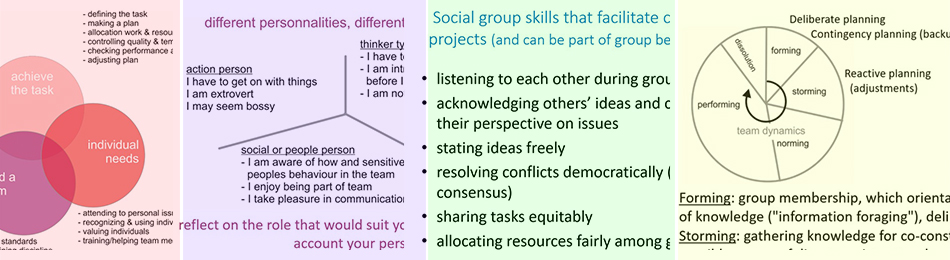
This instruction consists of a 10 minute presentation outlining group functioning and challenges: achieving the task, constructing and maintaining group effort and taking into account the individual needs of group members (Asgari & Dall’Alba, 2011). Students are also informed that task delegation should take into account the different personalities within the group; taking benefit of social, cerebral or extrovert traits. Finally, students were informed about group dynamics in which the emphasis was placed on possible disruptions that may occur within the group when: making strategic decisions (direction of the project, deliberate planning), co-constructing knowledge (transactive dialogue), delegating necessary tasks, adjustments (reactive planning), controlling time limits or when members do not comply with the ground rules (Tuckman & Jensen, 1977; Van den Bossche et al., 2006). The slide show that supports this instruction can be found at the bottom of this page.
Setting the Ground Rules
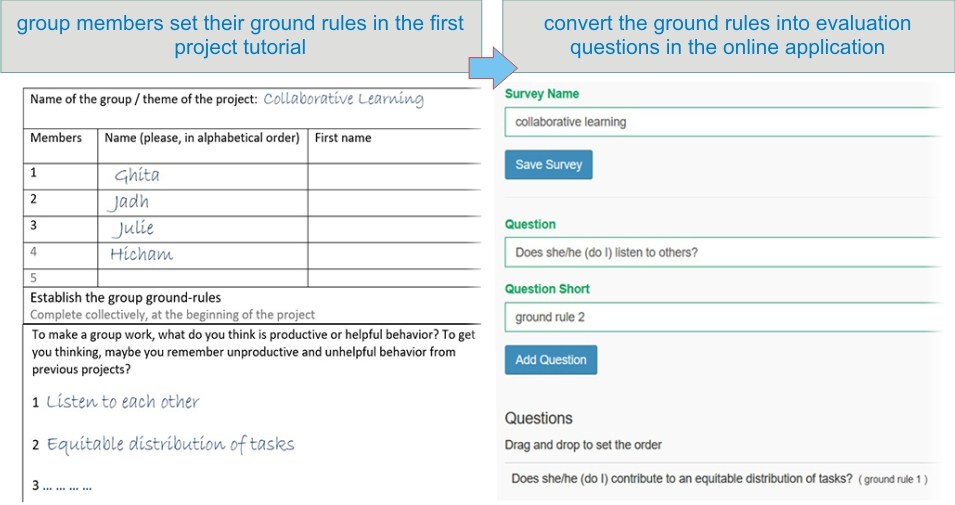
In the first tutorial session that accompanies a collaborative project, groups are given time to discuss their project and prepare a set of 5 to 7 ground rules. These numbers were chosen for two reasons: firstly, in prior experiences groups spontaneously came up with 5 rules and, secondly, this number allows for a nuanced, less subjective, assessment of the group members. Students hardly ever came up with 8 rules and more rules would unnecessarily complicate the assessment. Our reasoning for creating the ground rules themselves is that students understand their own criteria better than those prescribed by someone else (instructor or leaders), the criteria are more likely to be appropriate for the collaborative task in question and groups that establish forward-looking agreements about how they want to work together were shown to be more focused and motivated to implement self-corrections or make adjustments to team processes (DeChurch & Haas, 2008). The process normally takes roughly 30 minutes. The ground rules are converted into questions and are fed into a web-based self-assessment application (figure 3).
a brief instruction about collaborative projects
References
Asgari, S., & Dall’Alba, G. (2011). Improving Group Functioning in Solving Realistic Problems. International Journal for the Scholarship of Teaching and Learning, 5(1), Article 8. http://digitalcommons.georgiasouthern.edu/ij-sotl/vol5/iss1/8
Baker, M.J., Hansen, T., Joiner, T. & Traum, D. (1999). The role of grounding in collaborative learning tasks. In P. Dillenbourg (ed). Collaborative learning: cognitive and computational approaches. pp. 31-63. Pergamon/Elsevier Science, Amsterdam. PDF
Brown, R.W. (1995, November 1-4). Autorating: Getting individual marks from team marks and enhancing teamwork. Proceedings Frontiers in Education, 25th Annual Conference, Atlanta, GA, USA. https://doi.org/10.1109/FIE.1995.483140
Conway, R., Kember, D., & Wu, A.S & M. (1993). Peer assessment of an individual‘s contribution to a group project. Assessment & Evaluation in Higher Education, 18(1), 45-56. https://doi.org/10.1080/0260293930180104
DeChurch, L.A. & Haas, C.D. (2008). Examining team planning through an episodic lens effects of deliberate, contingency, and reactive planning on team effectiveness. Small Group Research, 39, 542–568. https://doi.org/10.1177/1046496408320048
Freeman, M., & McKenzie, J. (2002). SPARK, a confidential web–based template for self and peer assessment of student teamwork: benefits of evaluating across different subjects. British Journal of Educational Technology, 33: 551-569. https://doi.org/10.1111/1467-8535.00291
Lejk, M., & M. Wyvill. (2001a). Peer Assessment of Contributions to a Group Project: A Comparison of Holistic and Category-based Approaches. Assessment & Evaluation in Higher Education, 26(1), 61–72). https://doi.org/10.1080/02602930020022291
Lejk, M., & M. Wyvill. (2001b). The effect of the Inclusion of Self-assessment with Peer Assessment of Contributions to a Group Project: A Quantitative Study of Secret and Agreed Assessments. Assessment & Evaluation in Higher Education, 26(6), 551–561. https://doi.org/10.1080/02602930120093887
O’Neill, T.A., Deacon, A., Gibbard, K., Larson, N., Hoffart, G., Smith, J., & Donia, B.L.M. (2018). Team dynamics feedback for postsecondary student learning teams, Assessment & Evaluation in Higher Education, 43(4), 571-585. https://doi.org/10.1080/02602938.2017.1380161
Tuckman, B., & Jensen, M.A.C. (1977). Stages of small-group development revisited. Group & Organization Studies, 2(4), 419-427. https://doi.org/10.1177/105960117700200404
Van den Bossche, P., Gijselaers, W.H., Segers, M., & Kirschner P.A. (2006). Social and cognitive factors driving teamwork in collaborative learning environments. Team learning beliefs & behaviors. Small Group Research, 37(5), 490-521. https://doi.org/10.1177/1046496406292938
 group working and motivation